






































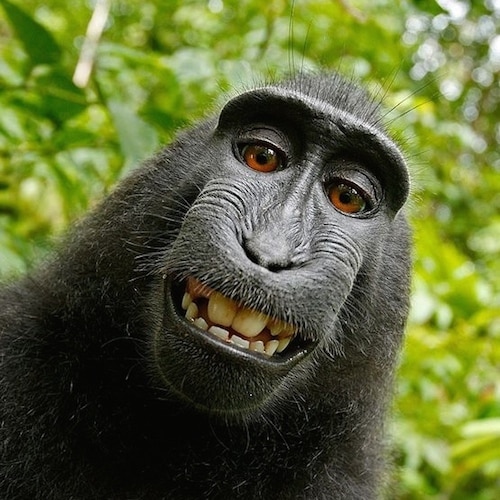
A copyright protects creative works to encourage artists, scientists, etc. to engage in intellectual and artistic efforts. From “Copyright 101?:
The primary purpose of copyright law is not so much to protect the interests of the authors/creators, but rather to promote the progress of science and the useful arts — that is — knowledge.
Of course, PETA ignores all of that, as it files a lawsuit to grant a copyright to a monkey that happened to take its own photo on a camera set up by a professional photographer to obtain unusual shots of animals. From the International Business Times story:
People for the Ethical Treatment of Animals (PETA) wants a macaque monkey, who took some famous selfies in 2011, to be the copyright owner of the pictures, according to a federal lawsuit filed by the animal rights group Tuesday.
The filing stated the group sought a court order to authorize PETA to manage income from the selfie images and use it for the benefit of the monkey and its community.
A few obvious points:
- The monkey doesn’t deserve a copyright because it did not engage in a creative or intellectual act. It had no idea it was “taking a selfie.” Indeed, it was curious, but oblivious about photos and cameras.
- Hence, granting the monkey a copyright would not “promote” anything.
- If anyone is entitled to the copyright, it would be the photographer whose creative act of placing the camera made it possible for the photo to be snapped. (It is apparently in the public domain.)
- PETA certainly shouldn’t benefit from the photo, as it had nothing whatsoever to do with its creation.
- This is another in a long series of frivolous lawsuits filed by PETA. The group will continue to abuse the legal system until and unless judges start imposing sanctions against the litigious organization as a deterrent.
This is a small example of a concerted attempt in animal rights, radical environmentalism, bioethics, and other areas to undermine human exceptionalism. As such, it should not pass without notice.
Image credit: Self-portrait by the depicted Macaca nigra female. See article. (NBC News (mirror)) [Public domain], via Wikimedia Commons.
