






































Writing about atheist oracle Stephen Hawking’s Discovery Channel program “Did God Create the Universe?,” an episode of Curiosity, the L.A. Times reviewer candidly threw up her hands in surrender.
[Hawking’s] attempts to explain how, exactly, the big bang emerged from a state of nothingness required an understanding of physics that was beyond me. “If you are not a math head,” he concedes far too late in the proceedings, “this may be hard to understand.” Indeed.
So, like its alternative, belief in Hawking’s premise is an act of faith.
What you really need to evaluate the strength of Hawkings’s argument, presented in his 2010 book The Grand Design, is either a head for math or, better still, an actual mathematician. Enter John C. Lennox, Oxford University professor of mathematics, who conveniently will speak in Seattle this Friday night, August 19.
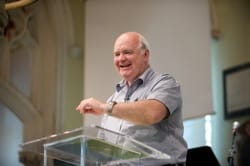
You couldn’t ask for a more expert “math head,” not to mention a highly endearing, funny and accessible speaker. Imagine your old Irish grandad if he was an Oxford don. He’ll be speaking at 7:30 pm on Friday at University Presbyterian Church. The title of his talk: “Do the laws of physics make God unnecessary?” More information here. Yes, it’s free.
In his own about-to-be-published book God and Stephen Hawking: Whose Design Is it Anyway?, Dr. Lennox sweeps Hawkings’s obscurities and obfuscations before him. Hawking’s signature argument is that because there’s such a thing as the law of gravity, the universe was guaranteed to self-create.
As Lennox makes clear, that makes about as much sense to the mind of a mathematician as it does to anyone else’s: “Nonsense remains nonsense, even when talked by world-famous scientists.”