






































Science and Culture Today Discovering Design in Nature
Month

November 2007

3 Myths About the Dover Intelligent Design Trial

Click here to display content from YouTube.
Learn more in YouTube’s privacy policy.

In 2005 Judge John E. Jones, presiding over the Dover intelligent design trial, ruled that intelligent design is religion, not science, because he felt he was in the best position to “traipse into such a controversial area” and settle the debate over intelligent design once and for all.

Tomorrow, PBS will air NOVA’s propaganda piece reenacting some parts of the Dover trial, “Judgment Day: Intelligent Design on Trial.” PBS claims the program will tell the true story behind the Dover trial. But will it?

The program features the usual cast of characters: anti-ID activist Eugenie Scott, Darwinist Ken Miller, and apparently Judge Jones himself (currently on his second annual self-congratulatory globe-trotting tour — be sure to catch him on your local NPR station and Air America). The program will attempt to show that intelligent design is creationism and therefore more religion than science. Like the misleading “Evolution” miniseries PBS produced in 2001, this is an attempt to stifle scientific inquiry and censor science by making talking and researching about intelligent design out of bounds.
Here are a few truths about intelligent design you won’t get from PBS/NOVA’s “Judgment Day” program.

Myth #1: There are no peer-reviewed scientific papers supporting intelligent design.
Judge Jones said that ID “…has not generated peer-reviewed publications.”

FACT: Judge Jones is simply wrong. Discovery Institute submitted an amicus brief to Judge Jones that documented various peer-reviewed publications, which he accepted into evidence. This is a fact-based question which is hard to get wrong. The fact is that there are peer-reviewed papers supporting intelligent design.

Read More ›
Was Justice Denied to Foundation for Thought and Ethics during the Dover Intelligent Design Trial?

Was justice denied to Foundation for Thought and Ethics during the Kitzmiller intelligent design trial? Whether or not it was, do you think NOVA will relate this information in their Judgment Day program about the trial next week? Don’t count on it.
Last year attorneys Seth Cooper and Leonard Brown published an article entitled, “A Textbook Case of Judicial Activism: How a Pro-ID Publisher Was Denied its Day in Court,” which describes how the publisher of the textbook Of Pandas and People, Foundation for Thought and Ethics (FTE), was denied the right to become a party to the Kitzmiller trial, despite the fact that its intellectual property rights were implicated in the lawsuit.

Interestingly, FTE had completed manuscripts of a new intelligent design book, The Design of Life, and at that time it was already under review for publication.

Read More ›

NOVA Program on Intelligent Design Biased,
Not by Chance but Because They Designed It That Way

First they dramatized the O.J. Simpson trial. Then they acted out Michael Jackson’s courtroom drama. This time around we have NOVA reenacting parts of the 2005 Dover intelligent design trial presided over by Judge John E. Jones.

As NOVA’s website points out, Paula Apsell, senior producer for NOVA’s propaganda piece on intelligent design, Judgment Day, felt “compelled” to make the docudrama. Journalists are usually only “compelled” to report on events by their editors, or by the newsiness (timeliness, proximity, impact, conflict, etc) of a specific issue/event.

So, why were Apsell and NOVA compelled to make this program?

Read More ›

Dr. West’s Heritage Foundation Lecture Now Available

For those of you who missed Dr. John West‘s lecture at The Heritage Foundation this week in Washington, D.C., it is now available online (look for November 6, 2007). West had a strained voice that day, yet he spoke eloquently on “The Abolition of Man? How Politics and Culture Have Been Dehumanized in the Name of Science.” In this lecture, he covers what he sees as five impacts of scientific materialism on public policy. If you like what you see, don’t forget to check out Darwin Day in America.

CSC Fellow Lecturing on ID at University of Buffalo and Daemen College

Today, CSC Fellow Paul Nelson will be speaking at the University of Buffalo and tomorrow at Daemen College on “Does the Complexity of Life Prove Intelligent Design?” The first lecture takes place at the University of Buffalo’s North Campus, in Cooke Hall, Room 121, on Thursday, November 8th at 8:00 pm. For directions click here. The lecture on Friday, November 9th is at 6:30 pm at Daemen College in the Wick Center Social Room. For directions to this location, click here.

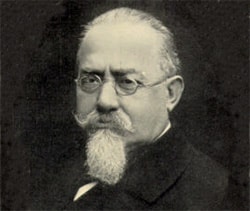
Meet the Materialists, part 4: Cesare Lombroso and the New School of Criminal Anthropology

Note: This is one of a series of posts adapted from my new book, Darwin Day in America. You can find other posts in the series here.

By the end of the nineteenth century, American scholars were already talking with excitement about the “new school of criminal anthropology” that sought to use modern science to identify the causes of crime. Leading the way was Italian criminologist Cesare Lombroso (1835-1909), whose book Criminal Man (1876) remains a landmark work in the field of criminology. Lombroso and his disciples contended that criminal behavior could be explained largely as a throwback to earlier stages of Darwinian evolution.

According to Lombroso, infanticide, parricide, theft, cannibalism, kidnapping, theft and anti-social actions can all be found throughout the animal kingdom, as well as among human savages. In earlier stages of development such behaviors aided survival and were therefore bred into animals by natural selection. As William Noyes, one of Lombroso’s American disciples, explained, “in the process of evolution, crime has been one of the necessary accompaniments of the struggle for existence.” While crime no longer served a necessary survival function in civilized societies, many modern criminals could be considered atavists—reappearances of characteristics from earlier stages of evolutionary development. According to Lombroso, such atavists were “born criminals,” exhibiting from birth the physical as well as behavioral characteristics of savages. Physical markers of such individuals included “abundant hair,” “sparse beard[s],” “enormous frontal sinuses and jaws,” “broad cheekbones,” a “retreating forehead,” and “volumnious ears.”

Read More ›

Looks Like Darwin Day Has Come A Little Early

Darwin Day in America that is. The new book by CSC associate director John West is now available in bookstores and online. If you missed West at the Heritage Foundation yesterday you can now watch or listen online. Abolition of Man? How Politics and Culture Have Been Dehumanized in the Name of ScienceWatch | Streaming MP3 | Save MP3 | Details

Rebuttal to Paul Gross’ Review of The Edge of Evolution – Error #3: Ignoring Behe’s Rebuttal of Exaptation Speculation

[This four part series responding to Paul Gross can be seen in: Part 1, Part 2, Part 3, Part 4.] An urban legend has cropped up among Darwinists that Michael Behe ignores indirect routes of evolution, commonly called “exaptation,” when he argues for irreducible complexity. In his review of The Edge of Evolution in The New Criterion, anti-ID biologist Paul Gross wrongly accuses that “Behe had failed to understand ‘exaptation’ (the use of an available part in function ‘B’ despite its original function ‘A’).” But in Darwin’s Black Box, Behe clearly accounts for exaptation and explains why it does not refute irreducible complexity: “Even if a system is irreducibly complex (and thus cannot have been produced directly), however, one can Read More ›

Bruce Chapman Is Pleased (Sorta)

The intelligent new on-line Seattle regional magazine “Crosscut“, edited by David Brewster, carries a column (as Anika Smith pointed out yesterday) called “Bruce Chapman is Right,” written by “Mossback” liberal Knute Berger. It generally agrees with recent comments of mine on Dr. James Watson and the battle over eugenics.

I hate to cavil after such welcome praise, but I have to demur from Berger’s one demurral. That is, when he says that we should remember that many Christian and Jewish clergy backed the original eugenics program in America, some heavy qualification is needed.

Read More ›

Behe’s Critics in Cahoots?

Michael Behe has a new blog series up responding to Nick Matzke’s review of his book in Trends in Ecology and Evolution, in three parts:

Part 1
Part 2
Part 3

As Behe notes, this review of Edge of Evolution is a real doozy, “a tediously disdainful review of The Edge of Evolution which revisits the blunders of previous reviews while adding new ones.”

It’s only when we get to Part 3 of his response that Behe reveals the identity of the reviewer to be none other than Nick Matzke, formerly of the NCSE. Behe thinks this is worth mentioning:

Read More ›

© Discovery Institute