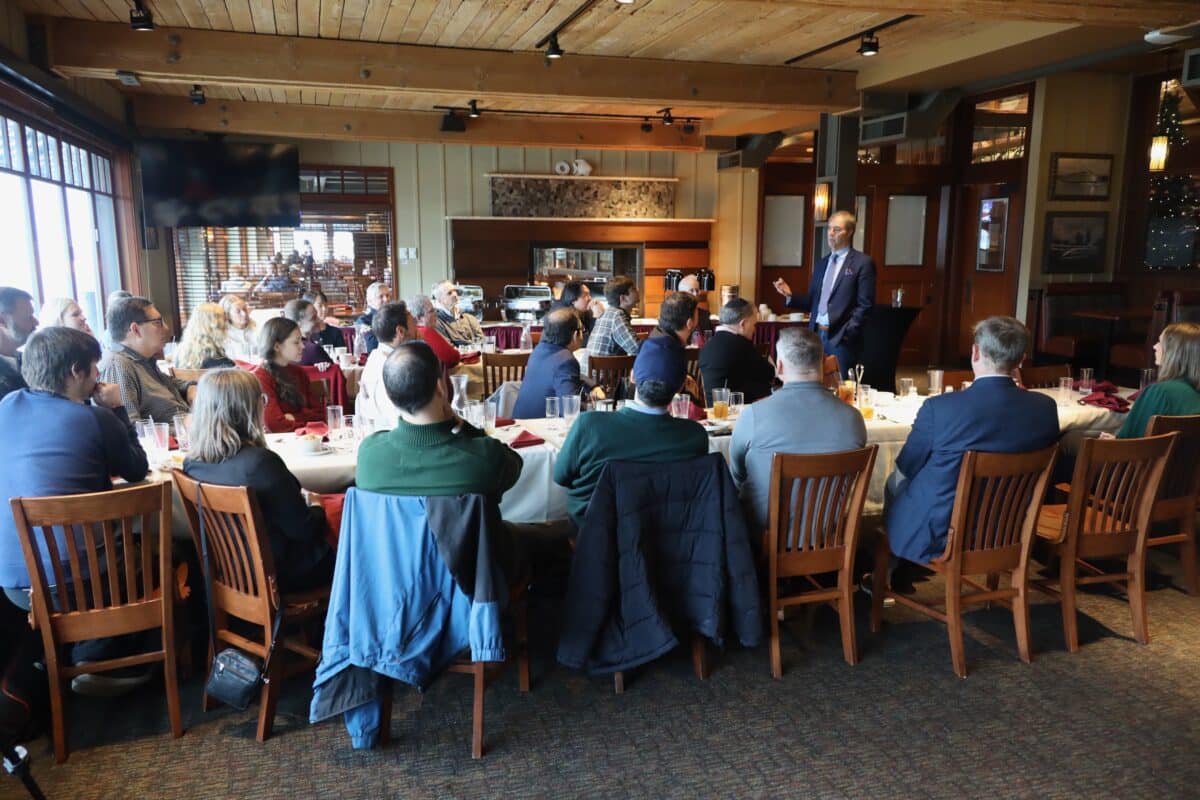
DI-Holiday-Party-2025-JZ0A1611-1200x800 Type post Author David Klinghoffer Date December 16, 2025 CategoriesCosmologyFaith & ScienceIntelligent Design Tagged , Anthropic Principle, articles, beginning, Big Bang, books, Center for Science and Culture, Charles Murray, earthquake, Elon Musk, floods, intelligent design, John West, Larry Sanger, machinery, megaphone, physics, pumps, Research, Return of the God Hypothesis, scientists, Seattle, social media, Stephen Meyer, Steve Buri, universe, Wikipedia, writing Charles Murray, Among Others, Shows the Impact of Our Work David Klinghoffer December 16, 2025 Cosmology, Faith & Science, Intelligent Design 4 As Stephen Meyer, John West, Steve Buri, and others got up and spoke, there was an odd shaking in the floor and windows. Read More ›
bacterial flagellum Type post Author Casey Luskin Date May 14, 2021 CategoriesEvolutionIntelligent Design Tagged , ATP synthase, bacterial flagellum, Cell (journal), Darwin's Black Box, human technology, intelligent design, Irreducible Complexity, Journal of the American Chemical Society, Judge John E. Jones, Kitzmiller v. Dover Area School District, last bacterial common ancestor, Michael Behe, molecular machines, motors, New Scientist, propeller, pumps, rotary engine, Salmonella, T3SS, University of Arizona Study Challenges Evolutionary Relationship Between Flagellum and Type III Secretory System Casey Luskin May 14, 2021 Evolution, Intelligent Design 9 There are various types of flagella, but all function like a rotary engine made by humans. Even non-ID scientists marvel at the complexity of these machines. Read More ›
ATP Synthase Type post Author Eric H. Anderson Date April 2, 2021 CategoriesEngineeringEvolutionIntelligent Design Tagged , ATP synthase, Charles Darwin, David Sivak, evolutionary narrative, intelligent design, molecular machines, motors, physicists, pumps, rotors, Simon Fraser University A Modest Invitation to David Sivak Eric H. Anderson April 2, 2021 Engineering, Evolution, Intelligent Design 3 Don’t burden your great research program with Darwin’s mid-1800s view of biology (or any modified descendant of Darwin’s general premise). Read More ›