






































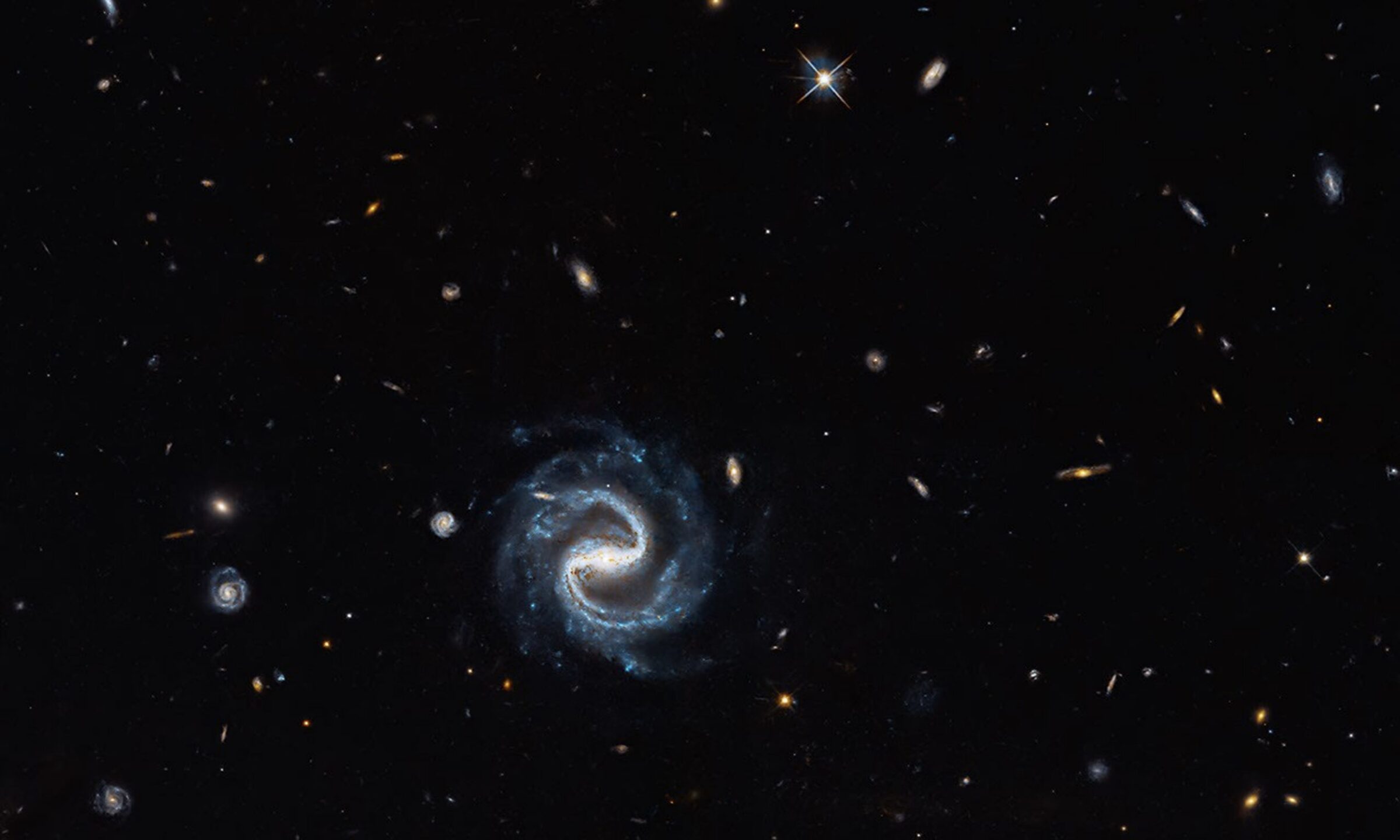
When we are asked to point to Heaven, we point up. But that’s not where Heaven is. That’s outer space. On the Mind Matters News podcast, our Bradley Center colleague Robert J. Marks shares a lecture he recently gave in his Baylor University course “Multidimensional Signal Analysis” entitled “Where Is Heaven?” The speculative talk approaches the concept of multiple dimensions from mathematical and theological angles to ask whether heaven might exist in dimensions beyond the ones we can perceive.
Dr. Marks first makes the point that our view of reality is partial. He explores what a higher-dimensional being might look like to lower-dimensional creatures. Then he turns to physics and math to explore time as a dimension, the extra dimensions of string theory, parallel universes, and Stephen Hawking’s argument that a 2D creature couldn’t exist. Drawing on famous literary and philosophical analogies — including Edwin A. Abbott’s Flatland, Plato’s Cave, and H. G. Wells’s “The Country of the Blind” — Marks illustrates how lower-dimensional entities are inherently limited in perceiving higher dimensions, just as humans bound to three spatial dimensions struggle to comprehend higher spatial realms or the nature of an afterlife.
The second half of Marks’s presentation applies higher dimensions to theology, exploring concepts like predestination and free will and drawing on the principle of establishing perspective. Marks demonstrates how a fourth spatial dimension could mathematically account for miraculous phenomena — such as walking through solid walls, breaking locked chains, or perceiving the interior of an object — without violating physical principles within that higher domain.
This thought-provoking lecture makes the argument that Heaven may not be a physical location “up” in skyward space, but rather an intersecting higher dimension that remains invisible yet intimately close. Download the podcast or listen to it here.
References
- R. J. Marks II, Handbook of Fourier Analysis & Its Applications. New York, NY, USA: Oxford University Press, 2009. Chapter 8: Multidimensional Signals
- E. A. Abbott, Flatland: A Romance of Many Dimensions. London, U.K.: Seeley & Co., 1884.
- H. G. Wells, The Invisible Man: A Grotesque Romance. London, U.K.: C. Arthur Pearson, 1897.
- H. G. Wells, “The Country of the Blind,” The Strand Magazine, vol. 27, pp. 401–415, Apr. 1904.
- S. W. Hawking, A Brief History of Time: From the Big Bang to Black Holes. New York, NY, USA: Bantam Books, 1988.
- W. L. Craig, Time and Eternity: Exploring God’s Relationship to Time. Wheaton, IL, USA: Crossway Books, 2001.
Television and Movies
- “Little Girl Lost,” The Twilight Zone, season 3, episode 26, CBS, Mar. 16, 1962.
- R. Donner, director, Superman: The Movie. Warner Bros., 1978.
Cross-posted at Mind Matters News.