



































In my previous article, I discussed the research of mechanical engineer Stuart Burgess on vertebrate limbs, as reviewed in our BIO-Complexity paper, “The Broad Utility of the Theory of Intelligent Design to Guide Scientific Research.” In other posts, my co-authors summarized sections of the paper that addressed the broader framework for design-based research and showcased specific applications (here, here, here, here). In this article, I will focus on another example from our review: pediatric neurosurgeon Michael Egnor’s research into the regulation of blood flow within the brain.
The Mystery
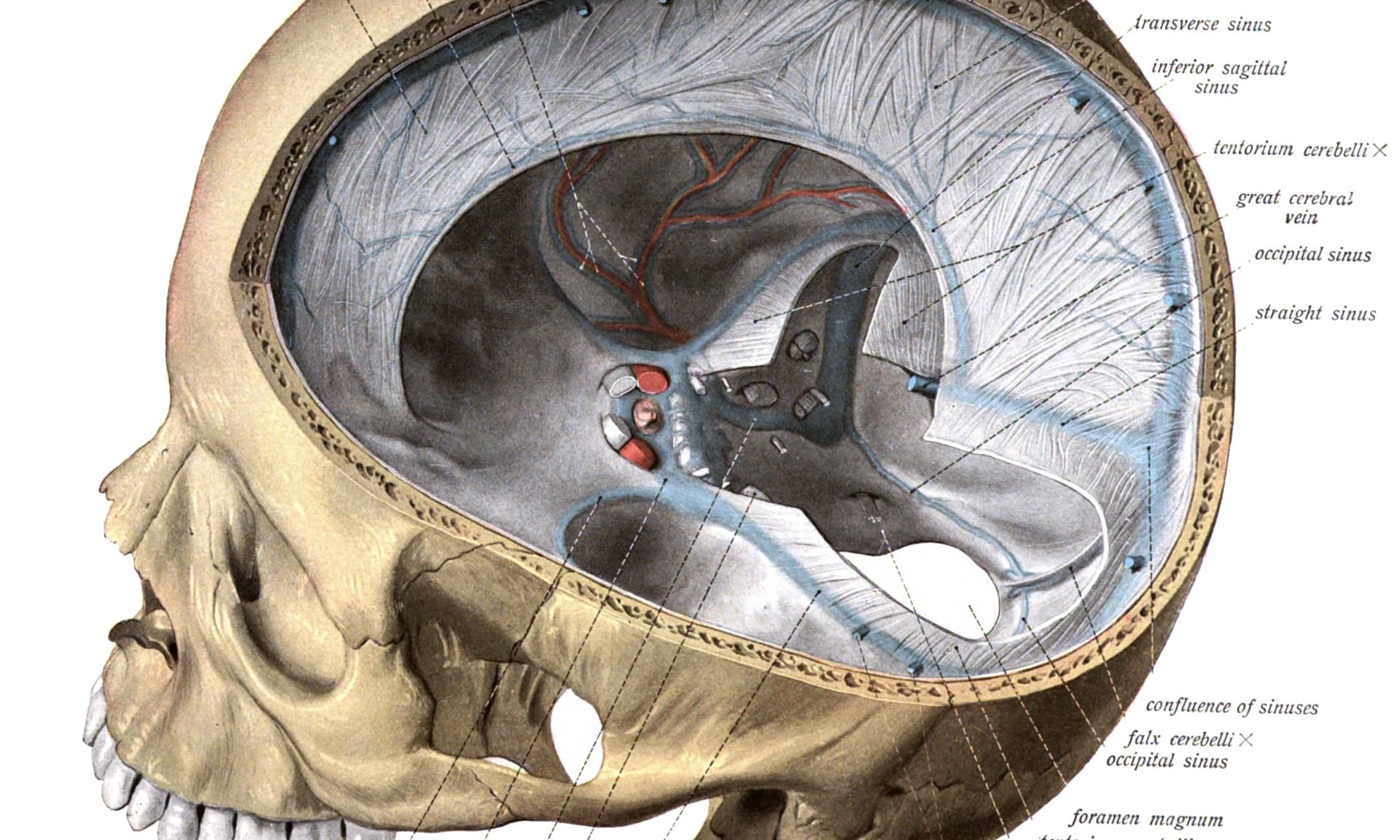
The heart pumps blood in pulses, causing blood flow to rise and fall with each beat. Yet the brain’s delicate capillary network requires protection from such large oscillations in blood pressure. This problem is solved through what is termed the cerebral Windkessel effect: the buffering of oscillations by the coupled behavior of arteries, veins, supporting tissues, and cerebrospinal fluid.
Explaining precisely how the system moderates cerebral blood flow has been a longstanding mystery, until Egnor approached the problem from a design perspective. In his foreword to the second edition of The Design Inference, he describes applying the explanatory filter to the dampening mechanism of the cerebral pulse and inferring design. Importantly, he did not regard the inference to design as the end of his investigation. Instead, it motivated him to ask how engineers solve comparable problems.
From Inference to Research Program
Egnor studied engineering techniques for suppressing vibrations in machines, electrical circuits, and fluid-carrying pipes. He discovered that a standard strategy was implementing a band-stop filter, which dampens oscillations in a select frequency range. In our review, we summarize the resulting engineering-based hypothesis for cerebral blood flow and how it led to a breakthrough in understanding the Windkessel effect (p. 31):
Applying the assumption that the brain is a “designed system” operating under engineering principles, Egnor and colleagues applied concepts from electrical engineering and reported that brain capillary blood flow is controlled by a band-stop filter, and cerebrospinal fluid flow is controlled by a band-pass filter. This article exemplifies how the design paradigm can be useful to scientists who seek to understand how biological systems function. By viewing biological systems as designed, researchers expect them to exhibit certain engineering principles that we observe in human-designed technology. This can help solve questions that are vexing biologists and clinicians. [Citations removed, here and below.]
The new model of cerebral blood flow not only helped solve a longstanding biological mystery but also opened promising avenues for improving the diagnosis and treatment of neurological disorders involving abnormal intracranial pressure and fluid dynamics, as we describe:
This model of brain blood flow has wide potential for improving treatments of hydrocephalus and “may provide new and counterintuitive insight into disorders of intracranial dynamics,” and points to “a new understanding of the pathophysiology and treatment of hydrocephalus and other disorders of intracranial dynamics” which resolves “serious problems with the pressure-volume models of intracranial dynamics.”
Implications for the Design Debate
Egnor’s research represents an iconic example of how applying the design framework to the study of living systems accelerates progress. He followed the general framework outlined in our paper:
- Observation: Egnor studied how engineers dampen oscillations.
- Prediction: Egnor predicted that human anatomy would employ similar principles, so he created an engineering model for blood flow.
- Experiment: He studied the anatomy and physiology of cerebral blood flow and found that his model perfectly matches observations.
Like Stuart Burgess, Egnor has demonstrated how a design-based approach can generate more accurate predictions and yield greater insights than assuming living systems are the product of undirected processes. Even further, his work illustrates how recognizing engineering principles in living systems can lead to a deeper understanding of their operation, generate more accurate models, and open promising avenues for innovation. Far from being a science stopper, the design framework can inspire and guide a fruitful research program.