






































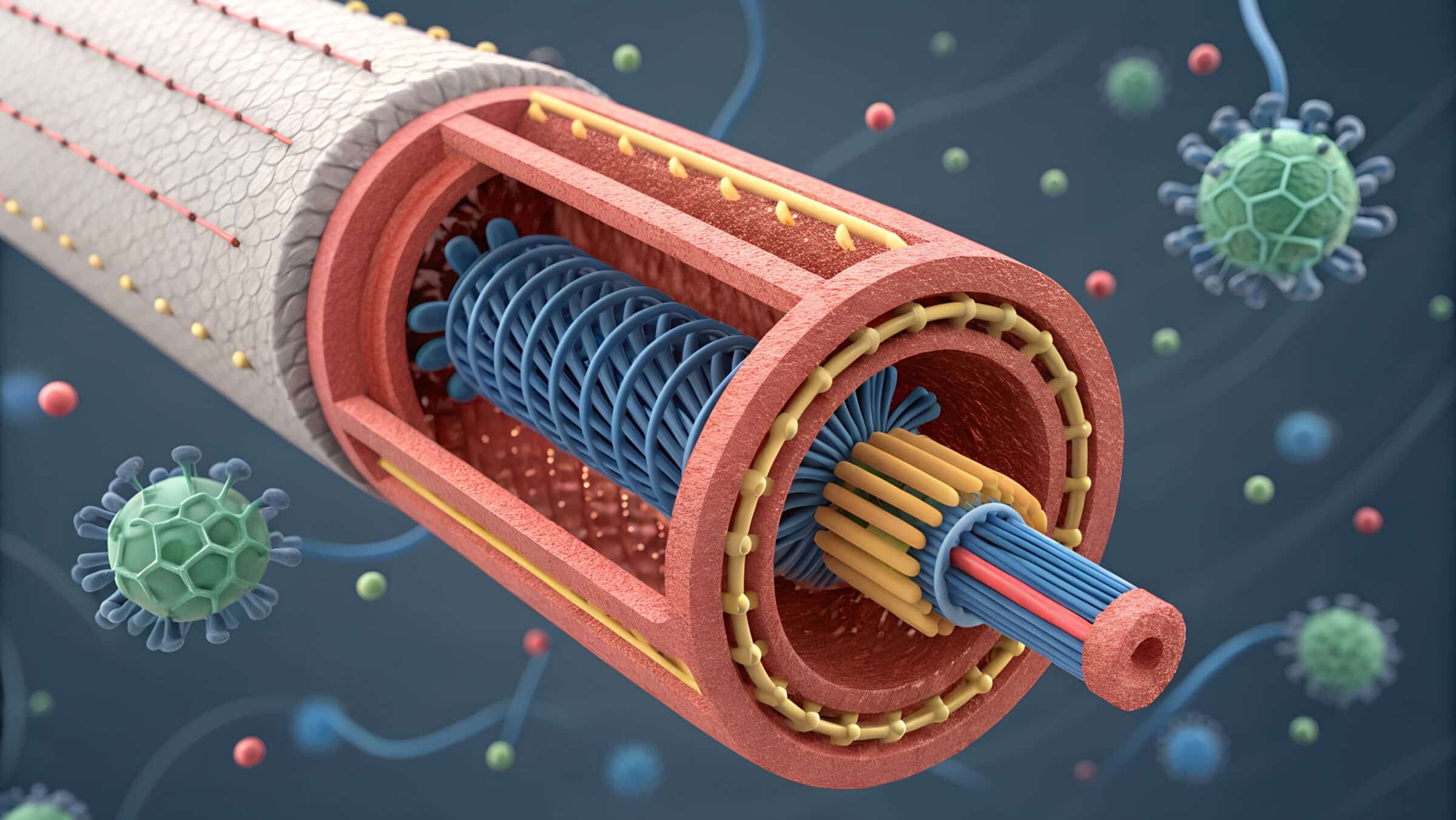
Michael Behe’s prescient recognition of irreducible complexity in the bacterial flagellum, mocked at the 2005 Kitzmiller v. Dover trial, has been further supported just in time for the trial verdict’s 20th anniversary tomorrow by research published this month in PNAS. Three Harvard physicists report: “Torque-generating units of the bacterial flagellar motor are rotary motors.” That is, bacterial flagellar motors are not vaguely like rotary motors. They ARE rotary motors, just like Dr. Behe said.
Behe had first written about the flagellum years before, in Darwin’s Black Box, but three specific-to-Dover ID predictions, while not strictly scientific in nature, have also been shown to be correct.
As Casey Luskin notes in a new ID the Future conversation, Discovery Institute before the trial urged the Dover school district against its ill-considered intelligent design policy. Why? Because we felt at the time that politicizing ID that way would lead to persecutions of ID scientists. As it did. (See the 2008 documentary Expelled: No Intelligence Allowed.) The issue of whether nature bears evidence of design needs to be adjudicated in science journals and science labs. Turning it into a court case would complicate that.
As Dr. Luskin says, the incompetent Dover decision was only a “speed-bump” for ID. But it remains true that scientists, post-Dover, are not anywhere near being fully at liberty to test the design hypothesis, free of intimidation. We constantly have to warn young scientists to be very careful about with whom they discuss their ID interests. An issue like that came up for me just yesterday. Our prediction, unfortunately, was on target.
Vindicated Many Times Over
Also at the time of the Dover ruling, the day after the decision appeared, John West made two further predictions. He did so in a USA Today op-ed. First, “Try to ban an idea,” that is, ban it by a court fiat, “and you will generate even more interest in it.” In the context of intelligent design, that prediction has been vindicated many times over. See Casey Luskin here on the state of the ID debate. The “banned” idea is making great progress.
Second, says Dr. West, “The more Darwinists resort to censorship and persecution, the clearer it will become that they are championing dogmatism, not science.” That’s another prediction, related to the one before but distinct, that has been shown to be prescient. We’ve heard from plenty of people whose interest in design evidence was aroused precisely because of the harshness, arrogance, and deceptiveness of the evolutionary dogmatists.
Before Wikipedia co-founder Larry Sanger revealed that he had been persuaded by Stephen Meyer and others to re-evaluate the God Hypothesis, Sanger had, back in 2017, complained of the “appalling bias” against ID in Wikipedia’s coverage of the evolution debate. It’s interesting that Elon Musk, who now affirms a Creator behind the universe, is backing Grokipedia which gives intelligent design a startlingly fair shake.
See my comments, too, on some seemingly unlikely high-level defections from materialism. Darwinist bias has backfired on itself.
So, There You Have It
Three predictions: 1) Politicizing ID by forcing it into public schools would attract unjust persecution. 2) Trying to legally ban ID, as Judge John E. Jones did in the middle section of Pennsylvania, would only heighten interest in it and advance the idea. And outside the legal context, 3) dogmatism in science would make thoughtful people suspicious of the dogmatists.
In science, a theory is judged by the predictions it makes about reality. These are not formal scientific predictions, of course, like ID’s accurate prediction that “junk DNA” would be found increasingly to be functional.
But the predictions noted above show that ID advocates foresaw what the Dover case and Judge Jones’s decision would lead to. Darwinists don’t appear to have foreseen any of it. Score 3 points for us, and 0 for them.