






































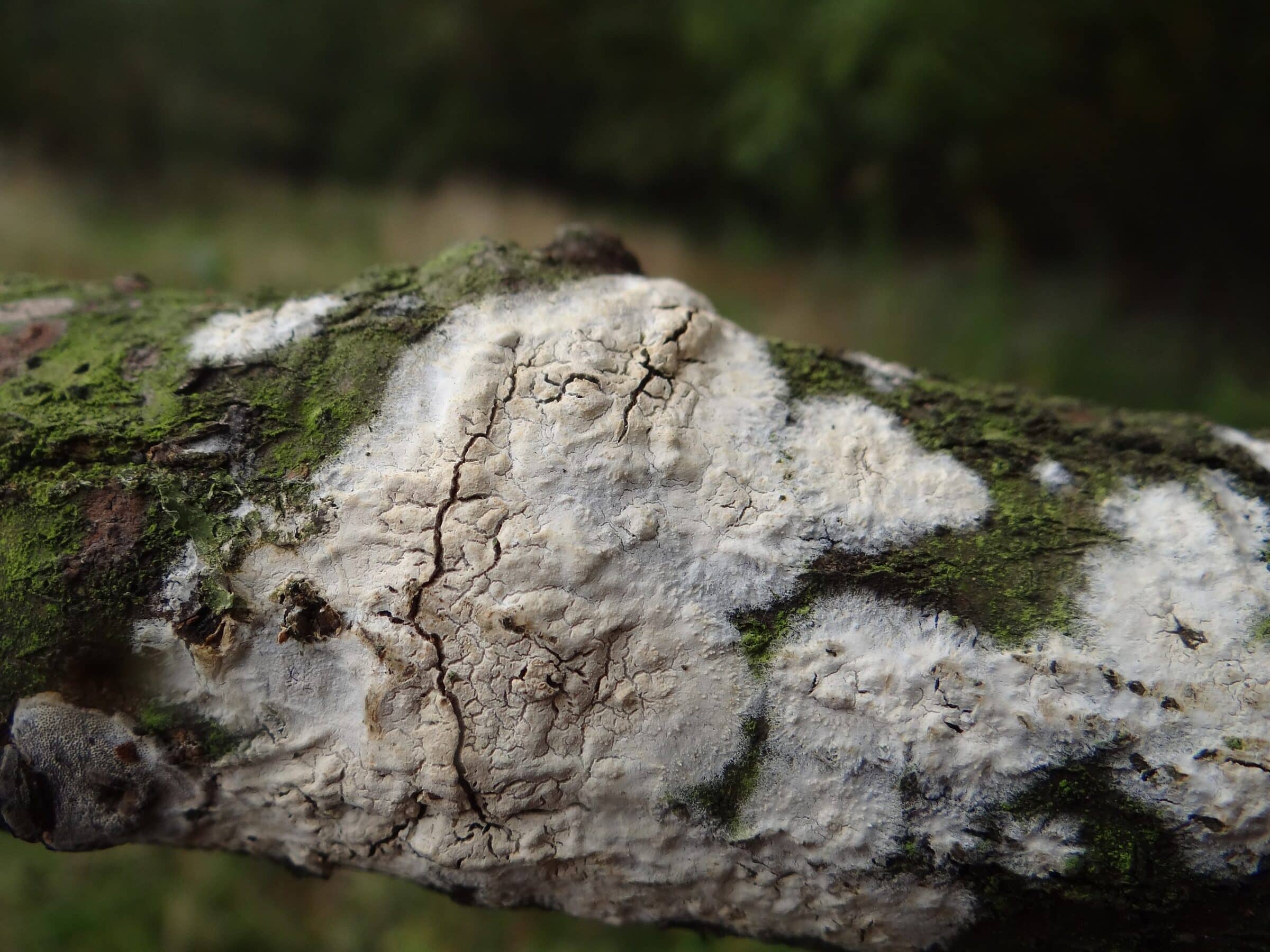
At the BBC’s Science Focus, Hayley Bennett reports that “New research on fungi suggests they could be demonstrating some form of intelligence, but not all experts are convinced.”
The reason not all experts are convinced is that a lot depends on what we mean by intelligence.
In recent years, research on fungi and slime molds has demonstrated a capacity for life forms without brains to recognize and remember patterns and make collective decisions. As she reports, an interesting experiment by Yu Fukasawa et al. (2024) at Tohoku University in Japan tested these traits in a fungus (Phanerochaete velutina, pictured at the top):
Using nine blocks laid out on the soil — in either the shape of a cross or a circle — they observed the fungi growing from the centre outwards. In the case of the cross, the fungi eventually left the middle blocks for the outer ones, as they searched further afield for more wood.
While Fukasawa notes that what they saw is just the fungi’s natural response to using up the resources in the centre, he still views it as “very intelligent.” The fact that the fungi distinguish between inward and outward means they can recognise spatial direction, he explains.
“Fungi could be conscious. Here’s what that means,” July 7, 2025
Similarly, at Science Alert, Michelle Starr comments, “It’s the latest in a series of studies that suggest the creeping organisms vital to the decay processes of the floral world might have something shockingly similar to cognition.” She quotes Fukasawa:
“You’d be surprised at just how much fungi are capable of,” says microbial ecologist Yu Fukasawa of Tohoku University in Japan. “They have memories, they learn, and they can make decisions. Quite frankly, the differences in how they solve problems compared to humans is mind-blowing.”
“This Fungus Appears to Be Able to Recognize Shapes, Study Shows,” October 21, 2024
But What Do We Mean by Intelligence?
The qualities described are actually similar to machine cognition. Machines also recognize patterns, store data, and make decisions, according to their programming. Biologists did not formerly realize how complex fungi and similar life forms can be. So it wasn’t until they started testing them for these abilities that they discovered that fungi have them.
But a fungus colony’s ability to recognize and react to an environment is different from the intelligence of, say, a rescue dog learning a skill. The dog knows she is learning something and knows she wants to please her trainer — with whom she has a relationship. That is a considerably higher level of intelligent awareness than we are likely to find in the fungus colony.
The human level of awareness is different again. The trainer sees the bigger picture. She knows why the dog is being trained in search-and-rescue techniques. The dog would, of course, do what the trainer wants her to do. But humans can and must ask the why questions as well.
Thinking About Thinking
The human also experiences something else: She experiences herself knowing what she is doing and why she is doing it. That is called metacognition:
When we notice ourselves having an inner dialogue about our thinking and it prompts us to evaluate our learning or problem-solving processes, we are experiencing metacognition at work. This skill helps us think better, make sound decisions, and solve problems more effectively.
Marilyn Price-Mitchell, “What Is Metacognition? How Does It Help Us Think?,” Psychology Today, October 9, 2020
In other words, we are thinking about what we are thinking about — perhaps that is the ultimate in an abstract process because both elements of the process are immaterial.
So yes, the natural world is full of intelligence… And we are only scratching the surface of it!
But intelligence comes in many “layers”; they differ by type and by the powers they confer. We confuse the issue if we conflate them in such a way as to imply that the intelligence displayed by fungi is equivalent to that displayed by the humans who research them.
As more people become interested in panpsychism, nature rights, transhumanism, and other such causes, it will be useful to insist on clarity from those who are making claims for intelligence — whether natural, as with the fungus, or artificial, as with computers.
Cross-posted at Mind Matters News.