






































If you look at Jerry Coyne’s blog Why Evolution Is True from over the past weekend, you will find his rebuttal to what Coyne calls an argument from incredulity. He comments, “You will recognize this argument as the basis for Intelligent Design.”
We have taken Coyne’s rebuttal, deleted the inessentials, and placed in bold all of the inferential steps, credulous guesses, and other leaps of imagination. It is astonishing that anyone would think the result a scientific argument, or, even, an argument at all. From “A creationist writes in espousing the Argument from Incredulity,” suitably modified:
Let’s take the larval wasp…The way to address the incredulity argument is to postulate a plausible step-by-step process in which each step is adaptive….
In the case of the wasp, all that is required is that different larvae have different propensities to eat the organs of the spider. How could this happen? Well, presumably the different organs of a spider can be perceived differently by the larval wasp, either by their location or, more plausibly, by the fact that they “taste” different. If different wasps prefer different “tastes” (or internal locations), and some of that variation is based on variation in genes, then the problem is solved. … Over time, this results in the evolution of a behavior … And this is not implausible….
Well, all you need is a starting behavior that can be improved and refined… Of course that seems implausible because it requires that one envision fish that have some tendency to spit water in the first place, and of what use is that?
How could that evolve? While it’s not difficult to see that once you can acquire food by squirting insects and knocking them into the water, natural selection will then improve your aim, enabling you to judge distance, compensate for refraction, and so on….
Some archerfish use a similar technique to displace silt beneath the water, uncovering hidden prey. That’s pretty easy to explain, as you’re not really aiming but foraging, and you already have the equipment to do that: producing jets of water outside of your mouth, which is apparently common in fish. …
The New Scientist article that I found in about a minute of Googline [sic] says this…
“‘The big question is: how did they know beforehand which type of silt was which, and so how long they should blast it for?’ asks [Stefan] Schuster. The answer might be that they are adept underwater shooters in the wild, too.
“Which came first — aerial or underwater shooting — also remains to be established.
“‘Perhaps some tendency to produce underwater jets might have been there first, because this is widespread among fish,’ says Schuster. … ‘Many other fish and invertebrates forage by disturbing the ground, and this is probably the ancestral condition,’ says Alex Kacelnik of the University of Oxford. ‘Archerfish probably thus started with this ordinary skill then transitioned to targets probably at, or narrowly above, the surface and this created new selective pressures to focus and aim water jets at ever higher targets.’ … Schuster says the two techniques might have evolved in parallel …”
So here we have an initial condition whose evolution isn’t hard to understand. Once you squirt at the silt below you to uncover prey, selection would improve that ability, as would learning, and maybe you’d start homing in on things that you see in the sediment. You then have the ability to be a living squirt gun. If a mutant fish then simply squirted at an object it could see, but one at the surface or above the water, a successful squirt would bring you food, and, importantly, reproduction. You might in fact get more food than other individuals in the population who aren’t aiming at insects directly but just foraging willy-nilly, with most of their squirts being fruitless. And if that were the case, both selection and learning (apparently fish can learn!) would work together to improve the ability of archerfish to squirt at prey above the water. The compensation for refraction, intensity of squirt, and so on, would then be honed by both selection and learning.
Now I don’t know if this scenario really happened …
Well, he got that last part right.
We do not know whether Coyne’s self-satisfaction is more ridiculous than his self-assurance, or the other way around, but together they make a powerful combination. To his credit, he offers this delightful nature video of the archerfish at its work. You will enjoy it:
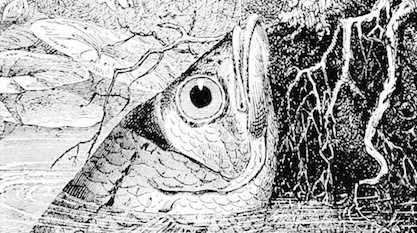
Illustration credit: A banded archerfish, from Popular Science Monthly Volume 44 [Public domain], via Wikimedia Commons.
