






































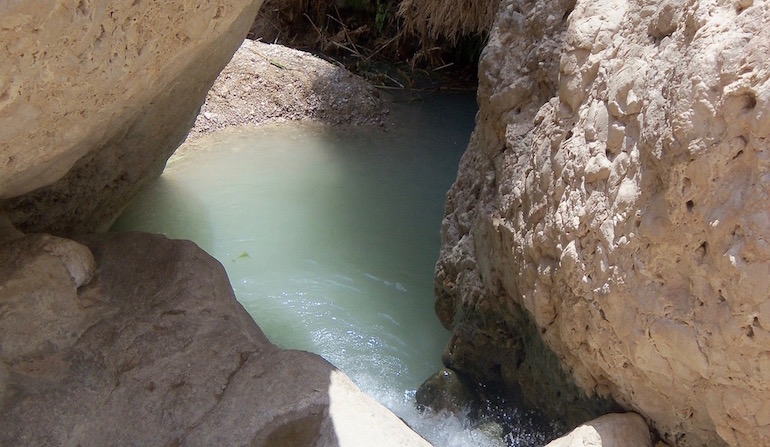
A new paper in the Proceedings of the National Academy of Sciences is frank about some of the problems facing the prebiotic synthesis of organics on the early earth. Here’s something amusing from the Abstract:
We find that RNA polymers must have emerged very quickly after the deposition of meteorites (less than a few years).
Really? That sounds amazingly good for origin-of-life research, until you grasp their reasoning:
[T]he rapid losses of nucleobases to pond seepage during wet periods, and to UV photodissociation during dry periods, mean that the synthesis of nucleotides and their polymerization into RNA occurred in just one to a few wet–dry cycles.
In other words, a “warm little pond” (as Darwin quaintly called it) is actually a very hostile environment for generating nucleotides. Why? Because within a year or two they’ll (a) lose their nucleotides due to “pond seepage” or (b) dry up, causing nucleotides to photodissaociate. So you must generate them very quickly before one of these terrible things happens and kills your nucleotides.
Since they know that RNA arose naturally, and since the nucleotide constituents of RNA are so fragile in “warm little ponds,” this means that RNA “must have emerged very quickly” in even “less than a few years” on the early earth.
Here’s another admission from the paper, noting that Miller-Urey type chemistry is unlikely to have produced prebiotic organics on the early earth:
As to the sources of nucleobases, early Earth’s atmosphere was likely dominated by CO2, N2, SO2, and H2O. In such a weakly reducing atmosphere, Miller–Urey-type reactions are not very efficient at producing organics. One solution is that the nucleobases were delivered by interplanetary dust particles (IDPs) and meteorites.
Again, they use the same backwards reasoning: They know there was a “warm little pond” and yet the earth’s early atmosphere was not conducive to generating organics. Therefore they came from outside of the earth on “interplanetary dust particles” (IDPs). Only one problem with that hypothesis, as they explain: “nucleobases have not been identified in IDPs”.
But if you could somehow get the nucleotides you then need to link them up into polymers. Hydrothermal vents are another popular hypothesis, except that the paper says they’re a bad place for polymerization:
[E]xperiments simulating the conditions of hydrothermal vents have only succeeded in producing RNA chains a few monomers long. A critical problem for polymerizing long RNA chains near hydrothermal vents is the absence of wet–dry cycles.
Thus, they like warm little ponds (WLPs) for generating organic polymers. But there are more problems to overcome, as they admit:
[T]he buildup of nucleobases in WLPs is offset by losses due to hydrolysis, seepage, and dissociation by UV radiation that was incident on early Earth in the absence of ozone.
They find that seepage is a major problem meaning that “Because of the rapid rate of seepage [~1.0 mm-d.-1 to 5.1 mm-d-1], nucleotide synthesis would need to be fast, occurring within a half-year to a few years after nucleobase deposition.”
Then there’s also a too hot/too cold problem:
Nucleotide formation and stability are sensitive to temperature. Phosphorylation of nucleosides in the laboratory is slower at low temperatures, taking a few weeks at 65° C compared with a couple of hours at 100° C. The stability of nucleotides on the other hand, is favored in warm conditions over high temperatures. If a WLP is too hot (>80° C), any newly formed nucleotides within it will hydrolyze in several days to a few years. At temperatures of 5° C to 35° C that either characterize more-temperate latitudes or a postsnowball Earth, nucleotides can survive for thousand-to-million-year timescales. However, at such temperatures, nucleotide formation would be very slow.
In other words, if it’s too hot, then you can generate nucleotides but they degrade quickly. If it’s too cold then they don’t degrade quickly but they are generated too slowly.
They prefer a “hot early Earth (50° C to 80° C) so that sufficient nucleotides build up and “[p]olymerization then occurs in one to a few wet–dry cycles to reduce the likelihood that these molecules are lost to seepage.” But a hot early earth means everything has to happen very quickly.
In other words, because there are so many problems facing the production of RNA, the only way it could have arisen is if it did so quickly that these destructive forces had no time to destroy the RNAs (and the precursor molecules).
Never mind that this paper provides no chemical pathway for forming RNA — under their rapid timescale or any timescale whatsoever. That’s because no such pathway is known to exist.
But why worry? We know the RNA world is true. It all must have happened this way.
Photo credit: A warm little pond, by rneitzey, via Pixabay.