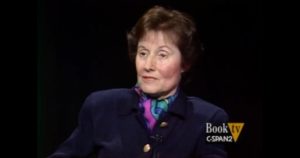
Gertrude Himmelfarb Type post Author Michael Flannery Date December 23, 2020 CategoriesEvolution Tagged , Brooklyn, Brooklyn College, Daniel Dennett, Darwin and the Darwinian Revolution, Darwin's Dangerous Idea, Darwinism, David Berlinski, Down House, Edmund Burk, England, George Eliot, Gertrude Himmelfarb, Irving Kristol, Jacques Barzun, James D. Watson, Janet Browne, Jews, Lord Acton, Oliver Cromwell, Protestants, Roman Catholic, The Devil’s Delusion, The New Republic, The People of the Book, Thomas Henry Huxley, University of Chicago #10 Story of 2020: Farewell to Gertrude Himmelfarb Michael Flannery December 23, 2020 Evolution 7 It is comforting to know that Himmelfarb never lost her intellectual acuity or her moral passion on the subject. Read More ›
C. S. Lewis Type post Author Michael D. Aeschliman Date August 16, 2020 CategoriesBioethics Tagged , Abraham Lincoln, Aldous Huxley, Aleksandr Solzhenitsyn, Alfred North Whitehead, Bertrand Russell, Brave New World, Clarence Darrow, Dante, Darwinian theory, David Hume, Deborah Blum, Frederick Douglass, Friedrich Nietzsche, From Darwin to Hitler, Fyodor Dostoevsky, G.K. Chesterton, Ghost Hunters, J. D. Bernal, J.B.S. Haldane, Jacques Maritain, Jane Austen, John Dewey, Justice Oliver Wendell Holmes Jr., Lord Acton, Malcolm Muggeridge, Marquis de Sade, Marxists, Michael Polanyi, Pierre Duhem, Samuel Johnson, Social Darwinism, Stanley L. Jaki, Superman, T.S. Eliot, That Hideous Strength, The Odyssey, Thomas Carlyle, William Jennings Bryan, William Shakespeare, Yuval Harari That Hideous Strength — C. S. Lewis’s Fantasia of Consciousness at 75 Michael D. Aeschliman August 16, 2020 Bioethics 14 The novel is a narrative, fictional version of a philosophical anatomy of the satanic dimension and implication of much modern history from 1914 onwards. Read More ›