






































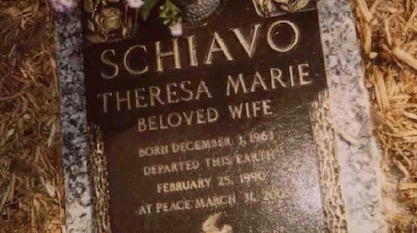
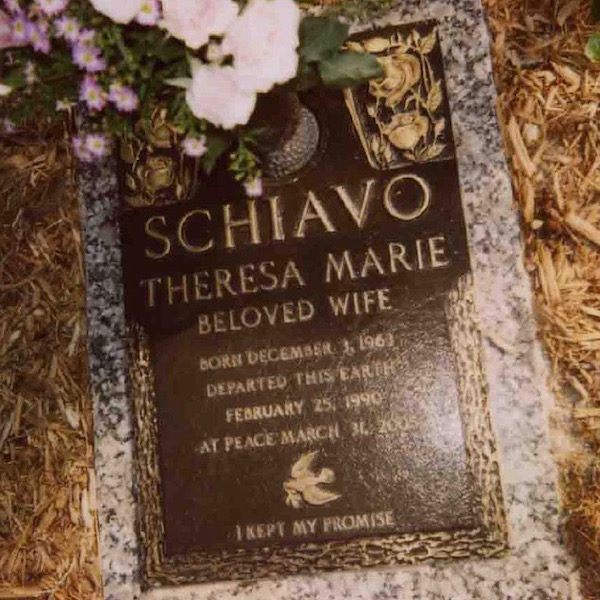
I was deeply immersed in the failed attempt to save Terri Schiavo’s life. Perhaps that’s why I feel duty-bound to correct every attempt to revise the case’s history.
Here’s the myth constantly pushed: Social conservatives interfered with the intimate family decision-making of devoted husband Michael Schiavo, who selflessly sought to obey the express wishes of his beloved Terri not to be kept alive if in a profoundly cognitively disabled state. That’s a profound distortion — to put it kindly — of what really happened.
The Latest Myth-Weaving
We find the latest such myth-weaving in a New York Magazine article criticizing the religious right for leaping to oppose the starvation death of Dutch teenager Noa Pothoven (which I did here, not because of religion but to defend the intrinsic value of life). I could deconstruct that nonsense too, but let’s stick with the Schiavo mendacity. From the piece by Sarah Jones:
Terri Schiavo had been in a persistent vegetative state for years by the time her husband, Michael, filed to remove her feeding tube. Her parents objected and instigated a legal battle. They found powerful allies: then-governor Jeb Bush, with an assist from brother George, tried to force Schiavo’s husband and her medical team to keep her on nutrition in a Florida facility.
Her husband insisted that Schiavo never wanted to be kept alive by artificial means. Doctors believed that she would never recover and was not aware of her surroundings.
Those facts didn’t matter to the Bushes, or to the Christian right, to whom Schiavo’s name became a rallying cry; her death, to them, was not a private tragedy but a collective sin, tantamount to murder.
It’s important to remember the truth:
- Michael Schiavo was not a loving husband but had essentially abandoned Terri to live with another woman — he called her his fiancé and they are now married – with whom he had sired two children by the time Terri died. If that doesn’t qualify as “estrangement,” what does? At the very least, it created a profound personal conflict of interest between Michael and Terri.
- Terri’s trial guardian ad litem recommended against dehydrating Terri due to Michael’s personal and financial conflicts of interest (if she died he stood to gain hundreds of thousands of dollars from the proceeds from a medical malpractice case). The response by the judge was to remove the guardian — and not appoint another, which was contrary to Florida law. (There were many legal irregularities on the road to Terri’s dehydration; if you want to know more, hit this link.)
- When Michael pursued the malpractice case, he testified that he would care for Terri the rest of her natural life, which experts testified could be many years — highly relevant to the issue of money damages. Somehow, the panel was never told that Terri might not live as long as expected because Michael would remove medical treatment. Within months of the money being in the bank, Michael tried to take away her antibiotics when she had an infection — thwarted by her family.
- The statements by Terri that she “wouldn’t want to live” were testified to by Michael and his brother-in-law — and even if true, were stated in very casual conversations. The family presented contrary evidence of conversations Terri had with friends. In any event, as a young woman, Terri unsurprisingly never made a clear, deliberate, and carefully considered decision about what she would want if she ever became so incapacitated.
- It wasn’t just social conservatives who wanted to save Terri, but also some on the secular left — such as the very liberal activists within the disability-rights movement, and Ralph Nader. Many on the religious left also opposed the dehydration. For example, Jesse Jackson traveled to Florida to stand in solidarity with the family at a demonstration.
- The federal Terri Schiavo law was one of the most bi-partisan passed during the Bush presidency. It received unanimous consent in the U.S. Senate, including from Hillary Clinton, Barack Obama, Joe Biden, Tom Harkin (who was a prime mover in support of the bill), Harry Reid, Dianne Feinstein, etc. Forty-five percent of the House Democratic caucus voting also supported the bill.
I could go on and on.
The Terri Schiavo case tore this country apart, and alas, proved a significant accelerant to the spread of the culture of death in America. But it was not — at least, not then — a matter of left versus right. Jones should learn her history instead of badly misleading readers in support of an ideological agenda.
Photo credit: GordonWatts at the English language Wikipedia [GFDL or CC-BY-SA-3.0], via Wikimedia Commons.

Cross-posted at The Corner.