







































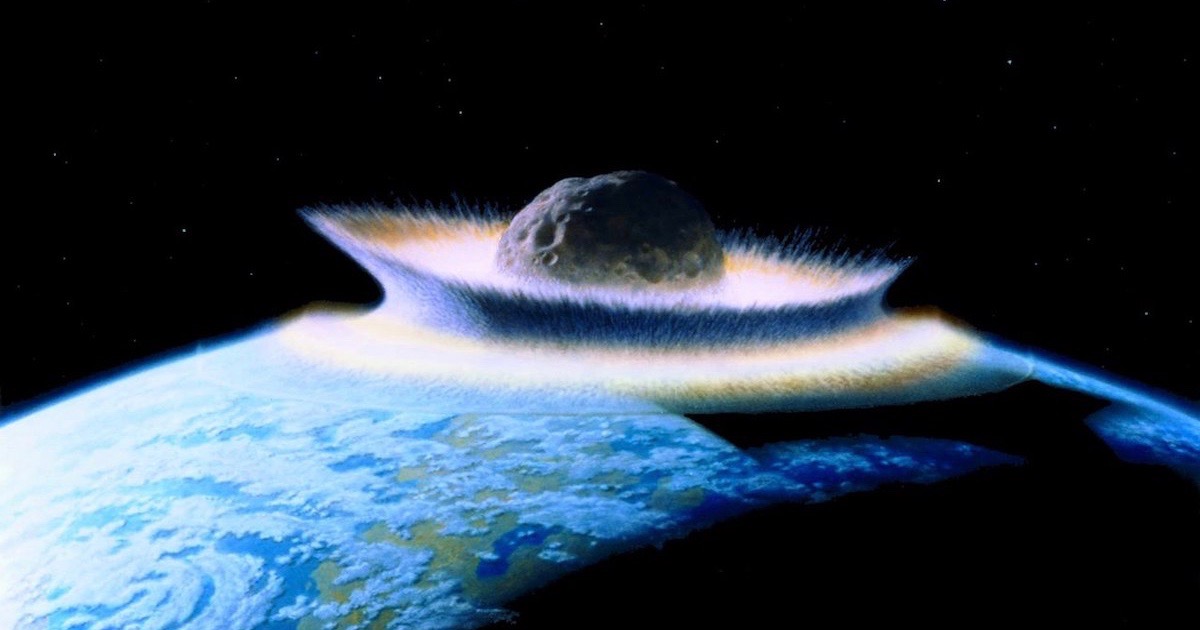
In 2002 I published a paper with two University of Washington graduate students in the journal Icarus. It was titled, “Rummaging through Earth’s Attic for Remains of Ancient Life.” Like an attic in a house, our moon serves as long-term storage for old things. In the paper we estimated the amount of Earthly material that we can expect to find on the Moon.
Wait. Pieces of Earth on the Moon? The Moon is far away. What’s more, Earth’s gravity holds on to its matter tenaciously, which is why it takes an asteroid or comet impact to blast bits of it into space. Seems like an unlikely way to get pieces of the Earth to the Moon. That’s true for the recent past, but the chances become much better if we consider the early Earth.
Two Things Going for It
Four billion years ago the Earth-Moon system had two things going for it that greatly increased the odds of the matter transfer. First, the Moon was much closer to the Earth, about one-third its current distance. This means that a larger fraction of the ejecta material made it to the Moon. Second, the impact rate on the Earth was much greater. We know this from the crater record on the Moon.
We estimated that the near lunar surface should contain about 7 parts per million of Earth material. Among the rock samples brought back by the Apollo astronauts, there should be about 3 grams of Earth material. We suggested searching the Apollo samples before attempting a direct search on the Moon. Still, we didn’t follow our own advice and soon thereafter submitted a proposal to JPL for a lunar mission to search for these rare materials. It was not funded.
Big Bertha
Fast forward to January 24, 2019. Results of a study of an Apollo rock sample called “Big Bertha” were published in the journal Earth and Planetary Science Letters. The authors concluded that a small 2 gram inclusion in the rock, picked up by the Apollo 14 astronauts by the Cone crater, most likely originated on Earth.
This discovery, assuming it holds up to additional study, nicely confirms our predictions. Not only does it demonstrate that pieces of Earth can be transported to the Moon, but it also shows that our estimate of the amount of material in the Apollo samples is in the right range.
Not surprisingly, this small bit of Earth has been subjected to alterations as it made it journey to the Moon. The researchers conclude that it originated at a depth of about 20 kilometers below Earth’s surface 4.0-4.1 billion years ago, it was blasted to the Moon and buried, and finally, it was excavated to the lunar surface by the impact that formed the Cone crater 26 million years ago. This small sample gives us chemical and isotopic clues as to its provenance, but it is unlikely to reveal anything directly about Earth’s early life.
The Discovery Principle
It was the question of early Earth life and the origin of life, in particular, that motivated me to undertake this research project. As I was working on it, I was also writing The Privileged Planet. The basic thesis of the book is that the universe is designed for scientific discovery. One implication is a very science-friendly idea I call the Discovery Principle, which is simply that we should be optimistic about answering important questions about nature through observation and experiment.
The origin of life seemed like an important question that should be amenable to empirical testing. However, given Earth’s continuing geological and hydrological activity, alteration of ancient rocks via multiple processes makes it unlikely we will ever find pristine samples of the first life on Earth. The Discovery Principle led me to consider looking to the Moon to study the origin of life empirically.
A Return to the Moon
True, most pieces blasted off the early Earth and landing on the Moon would have been at least partially melted and vaporized. However, a small fraction would originate at the Earth’s surface and be the least altered. It is this material that might contain traces of early Earth life. Finding it will require searching a large volume of lunar soil, probably as part of a permanent lunar village. In fact, searching for Earth meteorites on the Moon is now cited as one of the main scientific justifications for a return to the Moon.
I’m not claiming that, without the Discovery Principle, nobody would come up with the idea of Earth meteorites on the Moon as a way to study the origin of life. In fact a Spanish scientist proposed the same idea independently (as far as we know) and nearly simultaneously with our own proposal. What I am saying is that the fruits of research have reinforced a specifically design-based idea.
Image: A planetoid collides with the early Earth, by Don Davis (work commissioned by NASA) [Public domain], via Wikimedia Commons.
