






































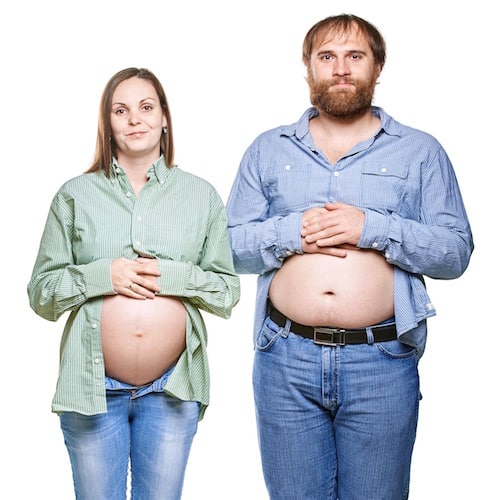
There has long been a subversive “anything goes” streak in bioethics. For example, Joseph Fletcher — one of the bioethics movement’s founding fathers, who also gave us situational ethics — sighed ecstatically at the prospect of men giving birth. From page 45 of his 1988 book The Ethics of Genetic Control:
[T]ransplant or replacement medicine foresees the day, after the automatic rejection of alien tissue is overcome, when a uterus can be implanted in a human male’s body — his abdomen has spaces — and gestation started by artificial fertilization and egg transfer.
Hypogonadism could be used to stimulate milk from the man’s rudimentary breasts — men too have mammary glands. If surgery could not construct a cervical canal the delivery could be effected by a Caesarean section and the male or transsexualized mother could nurse his own baby.
Fletcher was at war with the natural and longed for the day when man could manipulate the the created (or evolved) order into our own image. In this sense, he was a precursor of transhumanism. Fletcher’s dream of men as mothers may be gestating toward birth. From a Yahoo new story:
If science can transplant a uterus into a woman, can it transplant one into a man? The answer is yes.
Theoretically, men could receive a uterus, carry a baby to term, and give birth. But what really blew our minds is that the day of male pregnancy is closer than you’d think. “My guess is five, 10 years away, maybe sooner,” says Dr. Karine Chung, director of the fertility preservation program at the University of Southern California’s Keck School of Medicine.
Today, medical advances let transgender women adjust their biochemistry to suppress male and introduce female hormones, have breasts that can lactate, and obtain surgically constructed vaginas that include a “neoclitoris,” which allows sensation.
Until now, however, a place to carry the fetus — a womb of its own — was a major missing link. Uterus transplants could conceivably surmount that hurdle.
Biologically male mothers would be unethical and immoral from every angle one looks at the issue; whether the potential fatal harm to the man, treating new life as a mere experiment, or the obliteration of the concept of societal norms. But I am sure Fletcher’s sister in moral subversion, Oprah, would be the first to ask for an interview with the first biologically male mother.
Image: vitaliymateha / Dollar Photo Club.