






































Science and Culture Today Discovering Design in Nature
Latest

Intelligent Design 101: Ground Zero, the Burgess Shale

Categories
Evolution
Intelligent Design
Share
Facebook
Twitter/X
LinkedIn
Flipboard
Print
Email

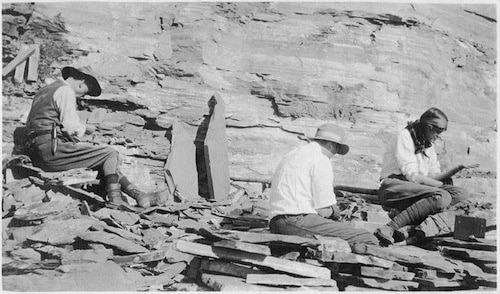
In 1909, Charles Doolittle Walcott, Secretary of the Smithsonian, literally stumbled upon the twentieth century’s most revolutionary fossil discovery.

Within the stones of the Burgess Shale, thousands of feet high in the Canadian Rockies, lay a treasure trove of middle Cambrian-era fossils, including many previously unknown animal forms, preserved in exquisite detail.

The discovery exposed a yawning gap in the evolutionary chain and raised more questions than Darwin’s theory of evolution by natural selection could possibly answer.

Learn more about the discovery of the Burgess Shale and other startling details that textbooks leave out.

Read Darwin’s Doubt.

PRE-ORDER TODAY

Image: Walcott excavating at Burgess Shale/Wikipedia.

Science and Culture

Science and Culture Today (SCT) provides original reporting and analysis about evolution, neuroscience, bioethics, intelligent design and other science-related fields, including breaking news about scientific research. It also covers the impact of science on culture and conflicts over free speech and academic freedom in science. Finally, it fact-checks and critiques media coverage of scientific issues.
Benefiting from Science & Culture Today?
Support the Center for Science and Culture and ensure that we can continue to publish counter-cultural commentary and original reporting and analysis on scientific research, evolution, neuroscience, bioethics, and intelligent design.

© Discovery Institute