






































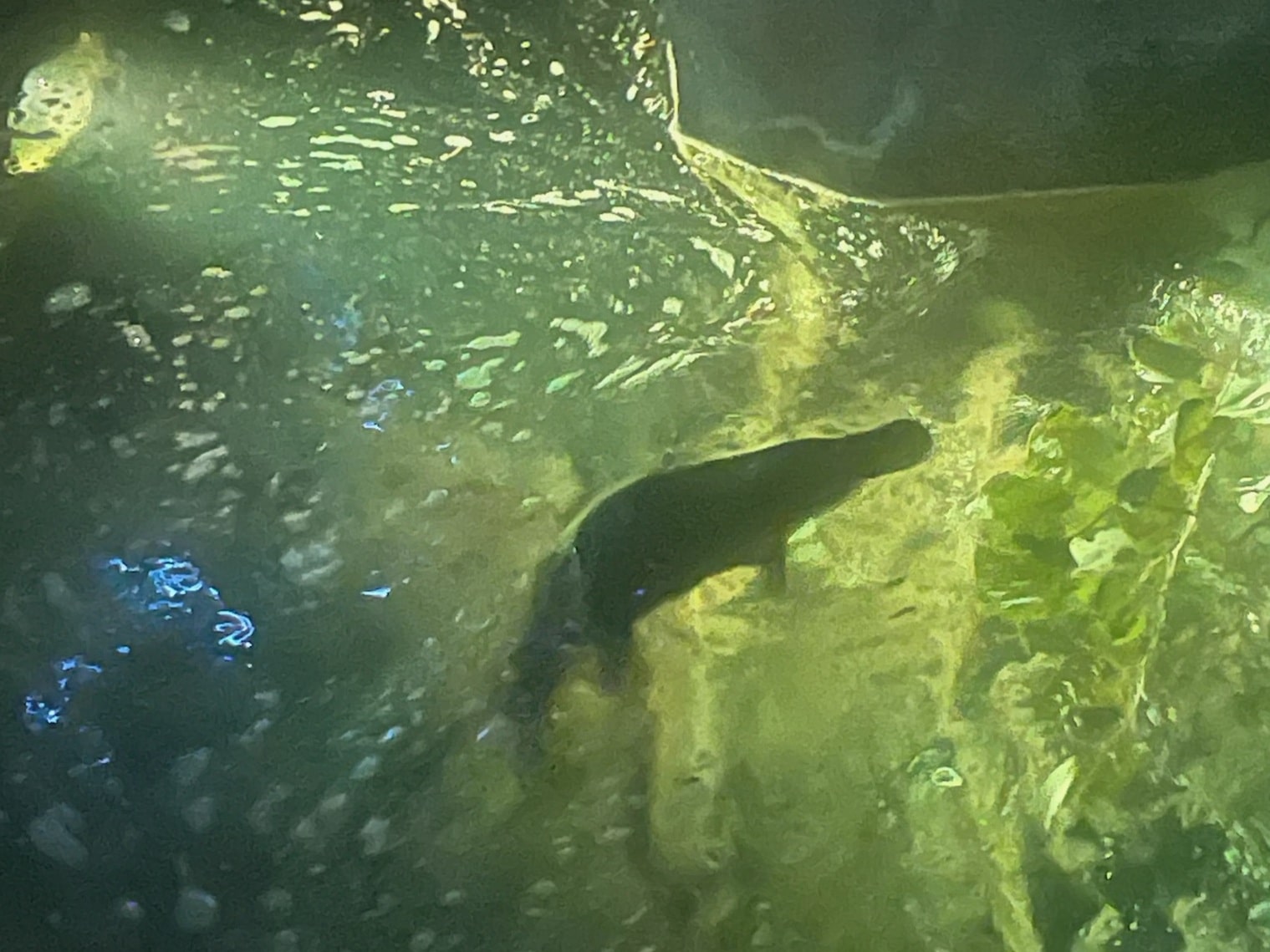
In An Evening at the Met in 1986, comedian Robin Williams, acting buzzed, said, “Do you think that God gets stoned once in a while? Look at a platypus. I think so.” He continued after the laughter subsided. “Okay, let’s take a beaver. Okay, let’s put on a duck’s bill. Hey, I’m God, what are you going to do? … Okay, he’s a mammal, but he lays eggs. Hey, Darwin! Yeah, there you go!” And then, he gave Darwin (backstage?) the proverbial middle finger. This routine was commonly included in his performances and it was called “Nature Has No Rules.” Some believe it was a classic.
No Rules, You Say?
Did Mr. Williams know that he was making an incredibly astute argument for intelligent design which is the counter argument to the theory of evolution or was he simply seeking laughs? Or, both? It’s hard to know, of course. I applaud him and his words nonetheless from far away and four decades later. Having been a practicing MD for nearly 50 years with a keen interest in intelligent design as well as an author who has written several books and lectured here and abroad on ID, I’ve repeatedly attempted to simplify the argument of intelligent design vs. Darwin (naturalism, materialism). But this is often a challenge when addressing a non-science audience. Philosophical arguments are not easy to follow. Scientific principles and biological processes often require some background knowledge. Not surprisingly, in many instances, religious arguments work for those inclined and they antagonize those who are resentful. And vice versa.
The platypus is a two-to-four-pound, egg-laying animal, native to Australia and Tasmania. Its unusual anatomy and physiology make a cogent argument against the theory of evolution look easy. Not against natural selection which fits all theories. One merely needs to show and tell the story. This jigsaw of unrelated species and seemingly incompatible traits could not have happened on its own. The absence of fossil records of transition species back this up. One might liken the platypus to an entity that is part automobile and part train that can burrow deep holes and navigate underwater.
Technically, this is a monotreme that looks like a beaver, has a duck’s bill, and stings with a heel spur like a reptile. And note, most importantly, mammals, supposedly, don’t lay eggs. In fact, this animal’s discovery by Europeans in the late 18th century was met with enormous mistrust. Stitching, especially, at the bill attachment was sought, but never found. Also, this bill is softer and made of different materials. it uses pebbles to grind up its food as it lacks a stomach. Also unlike other mammals other than monotremes.
Shrimp, Worms, and Insects
The platypus bill is loaded with 20-40,000 electroreceptors (like dolphins). It is swung back and forth along riverbeds to find shrimp, worms, and insects. Its body also looks like a baby otter and it is built for spending a lot of time hunting underwater. Its hairs, seen under a microscope, are more like hollow bird feathers, yet shaped differently. This “fur” also fluoresces blue-green in ultraviolet light And, of significant interest, the platypus also has webbed claws, but, In contrast, to birds, they crunch up when on land and make the animal look as if it were walking on its knuckles. Incredibly, this animal can stay underwater up to 11 minutes and drop its pulse to 1.2 beats per minute (bpm).
It gets crazier and crazier. Female platypuses lack nipples and feed their young by secreting milk through the skin on their chest and abdomen. Their eggs are delivered through the rectum much like the multi-functioning cloaca of chickens. Strikingly, they have an interclavicle in both shoulder girdles which is a very specific trait they share with reptiles only. That and the venomous spur. For unknown reasons, the female has two ovaries, but only one is functional.
Microscopic Differences
There are several microscopic differences also. In 2004, researchers at the Australian National University discovered the platypus has ten sex chromosomes compared to two (an X and Y) in mammals. One X chromosome has close homology to the bird Z chromosome. There are 52 total chromosomes and some are both reptilian and mammalian genes associated with egg fertilization. And it lacks the SRY gene which is the master sex determining gene found in most mammals.
It is readily apparent this animal is a very unique patchwork of mammalian, reptilian, and avian characteristics that cannot be explained by the theory of evolution. Its functions and anatomy abide by Michael Behe’s term irreducible complexity, for which I use “all or nothing.” Also, it is obvious that platypuses could not have come about by small, (Darwinian) successive steps, What’s the purpose of having a platypus without a bill or a partial bill, with an unnecessary stomach, or without electroreception, or a multi-functioning rectum without the ability to make eggs? Or partial eggs?
Indeed, to some of us, the platypus looks like an intelligent designer made it as a joke. Or created it as a clever, indignant response to those who say that all of life is a perfectly natural accident. Meaning, no designer. Maybe the platypus was deliberately designed to show doubters that that designer can do “whatever I want, whenever I want, and however I want.” And did so with a chuckle or two.