






































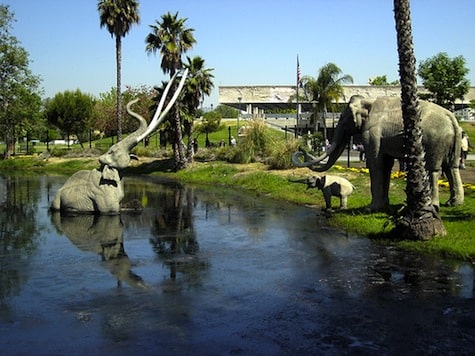
When I was growing up in Southern California, pretty much my favorite field trip was to the La Brea Tar Pits in Los Angeles, tomb of countless prehistoric animals that got stuck in the tar to be dug up later as fossils, for the wonderment of visiting school kids. The ongoing excavations have since been supplemented by a spiffy museum.
From the other side of a fence on Wilshire you can see the life-size models of a mammoth caught and doomed to drown in the tar as another adult and baby mammoth look on. It’s an L.A. landmark — and a nice illustration of one problem that bedevils Darwinian theory.
Commemorating “Darwin’s Legacy” for the website Skeptic.com, paleontologist and harsh intelligent-design critic Donald Prothero writes, based on his own work there, about the funny way the animals dredged up from the tar have of staying static over vast stretches of time. That is despite radically alternating environmental conditions of the kind that should stimulate some evolutionary action. The more things change the more they stay the same.
File this perhaps under “What They Say When They Think We’re Not Listening”:
After six years of work and publication, the conclusion is clear: none of the common Ice Age mammals and birds responded to any of the climate changes at La Brea in the last 35,000 years, even though the region went from dry chaparral to snowy piñon-juniper forests during the peak glacial 20,000 years ago, and then back to the modern chaparral again.
In four of the biggest climatic-vegetational events of the last 50 million years, the mammals and birds show no noticeable change in response to changing climates. No matter how many presentations I give where I show these data, no one (including myself) has a good explanation yet for such widespread stasis despite the obvious selective pressures of changing climate. Rather than answers, we have more questions — and that’s a good thing! Science advances when we discover what we don’t know, or we discover that simple answers we’d been following for years no longer work.
Emphasis added. Well said, Professor.