Science and Culture Today Discovering Design in Nature
Topic

Roman Catholic

Mainstream Media Now Picking up on Intelligent Design Discrimination Lawsuit Against NASA’s JPL

Last week we reported on a discrimination lawsuit filed on behalf of JPL employee David Coppedge. Over the weekend the San Gabriel Valley Tribune ran a lengthy story reporting on the suit. After Coppedge discussed intelligent design with JPL scientists, his supervisors told him to stop discussing religion. Last April Coppedge’s bosses demoted him. Coppedge had been a leader on the system administrator team for the Cassini mission, according to the suit. The paper also reports that after being ordered by his superiors at JPL to stop talking about intelligent design, Coppedge did just that. Even more interesting is this: Earlier this month Coppedge claims he met with his supervisors, who told him that the written warning was inappropriate and Read More ›

Responding to “Thomist” Critics of Intelligent Design

Preliminary Matters

I’m currently editing a volume called God and Evolution that deals with the general subject of theistic evolution (to be released by Discovery Institute this fall), and I am contributing a couple of chapters to the volume on Catholicism and ID. I’m also working on a book-length treatment of the same subject. As a result, over the last six months, I’ve been studying the relationship between Catholic theology and contemporary arguments for intelligent design.

Various “Catholic” assessments of ID have been appearing on for years, and no doubt will continue to do so. (See this 2007 article from the New Oxford Review, for instance.) But recently, a certain “meme” has begun to emerge that ID is somehow un-Catholic, contrary to the Catholic intellectual tradition, or some such. This seems to me to be a serious mistake that needs to be challenged directly. So one (though only one) of the purposes of the publications I’ve been working on is to respond to a cluster of criticisms of ID by some recent Catholic critics, including those by Ed Feser, Frank Beckwith, Michael Tkacz, and Stephen Barr. Some of these criticisms have taken place online, others in printed publications.

Unfortunately, the issues at stake are subtle and complicated, and often involve translations into somewhat different “conceptual schemes”; so it’s hard to deal with them adequately in the drive-by fashion appropriate to the blogosphere. Moreover, I don’t think that these gentlemen are all making exactly the same arguments, though their criticisms are related.

So there’s a danger of over-generalizing.

Since print publications have such a long gestation period, however, and the debate seems to be creating far more heat than light, I’ve decided to weigh in more promptly. My first response, to Stephen Barr, appeared several weeks ago. I’ll offer a few more responses here at Evolution News & Views, one at a time, over the next couple of months. (See also Vincent Torley’s response to Ed Feser over at Uncommon Descent, including the discussion in the comments section. Torley has promised more along these lines in coming weeks.)

Read More ›

Rabbi Hirsch, Darwin Dissenter

Despite the old canard that the only people to question Darwinian evolution are evangelical Protestants (a canard regurgitated yet again last week by the New York Times), the fact remains that Darwin dissenters can be found among thoughtful scientists and other people from all religions and walks of life. There have been many Catholic dissenters from Darwin, from St. George Jackson Mivart and G.K. Chesterton a century ago to biochemist Michael Behe and philosopher/theologian Benjamin Wiker today. There also have been numerous Jewish dissenters from Darwin. David Klinghoffer writes about one of them in an essay for First Things on Rabbi Samson Raphael Hirsch (1808—1888): Hirsch insisted again and again that God must be understood as acting with complete freedom Read More ›

Shoddy Engineering or Intelligent Design? Case of the Mouse’s Eye

We often hear from Darwinians that the biological world is replete with examples of shoddy engineering, or, as they prefer to put it, bad design. One such case of really poor construction is the inverted retina of the vertebrate eye. As we all know, the retina of our eyes is configured all wrong because the cells that gather photons, the rod photoreceptors, are behind two other tissue layers. Light first strikes the ganglion cells and then passes by or through the bipolar cells before reaching the rod photoreceptors. Surely, a child could have arranged the system better — so they tell us.

The problem with this story of supposed unintelligent design is that it is long on anthropomorphisms and short on evidence. Consider nocturnal mammals. Night vision for, say, a mouse is no small feat. Light intensities during night can be a million times less than those of the day, so the rod cells must be optimized — yes, optimized — to capture even the few stray photons that strike them. Given the backwards organization of the mouse’s retina, how is this scavenging of light accomplished? Part of the solution is that the ganglion and bipolar cell layers are thinner in mammals that are nocturnal. But other optimizations must also occur. Enter the cell nucleus and “junk” DNA.

Only around 1.5 percent of mammalian DNA encodes proteins. Since it has become lore to equate protein-coding regions of the genome with “genes” and “information,” the remaining approximately 98.5 percent of DNA has been dismissed as junk. Yet, for what is purported to be mere genetic gibberish, it is strikingly ordered along the length of the chromosome. Like the barcodes on consumer items that we are all familiar with, each chromosome has a particular banding pattern. This pattern reflects how different types of DNA sequences are linearly distributed. The “core” of a mammalian chromosome, the centromere, and the genomic segments that frame it largely consist of long tracks of species-specific repetitive elements — these areas give rise to “C-bands” after a chemical stain has been applied. Then, alternating along the chromosome arms are two other kinds of bands that appear after different staining procedures. One called “R-bands” is rich in protein-coding genes and a particular class of retrotransposon called SINEs (for Short Interspersed Nuclear Elements). SINE sequence families are restricted to certain taxonomic groups. The other is termed “G-bands” and it has a high concentration of another class of retrotransposon called LINEs (for Long Interspersed Nuclear Elements), that can also be used to distinguish between species. Finally, the ends of the chromosome, telomeres, are comprised of a completely different set of repetitive DNA sequences.

Read More ›

Benjamin Wiker on the Problem of Evil

This week Inside Catholic republished an absolutely brilliant essay by Discovery Institute Senior Fellow Benjamin Wiker on the problem of evil. This essay is one of the most thoughtful replies to the problem of evil — that the existence of evil evidences against God’s existence — I’ve seen packed into a short essay. It is a must read. Wiker describes how, in a feat of fuzzy thinking, evolution typically plays into dialogue on the problem of evil. Evolutionary answers to the problem, he argues, are more likely to do away with evil than explain it. And among the many important questions Wiker poses is whether we really want all evil purged from the earth. Take a look to see his Read More ›

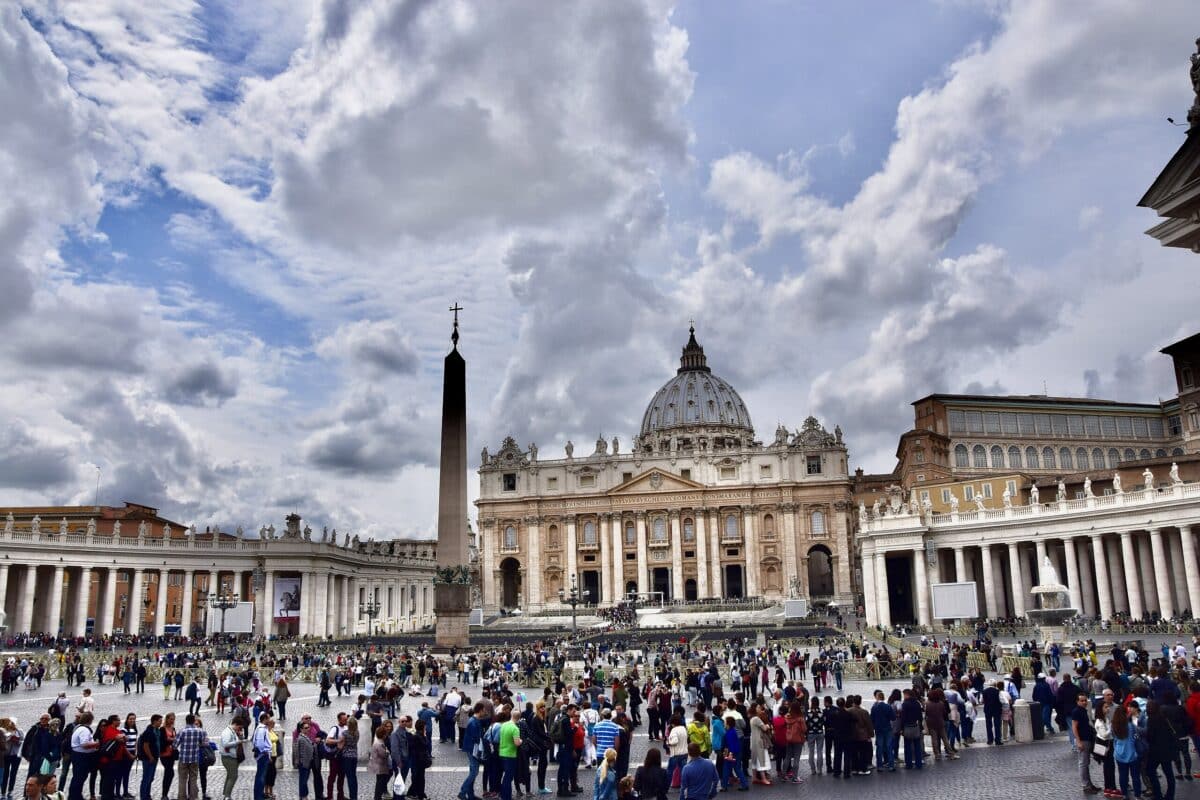
St._Peter's_Square_and_Basilica,_Vatican_(Ank_Kumar)_04
Photo credit: Ank Kumar, CC BY-SA 4.0 <https://creativecommons.org/licenses/by-sa/4.0>, via Wikimedia Commons.

Templeton’s Darwin Conference in Rome

“Do you know who funded it?” asked the email from the AP reporter. She and a number of other people read my post from three days ago about the Darwin conference being held in Rome. I took a deep breath and replied to the AP email, “Yes, I know who funded it.” It was the Templeton Foundation. I took a deep breath because Templeton is a powerful and well-connected. You don’t want to cross Charles Harper of Templeton if you can help it. But in public and private Harper has attacked intelligent design and Discovery Institute. He is not just interested in discussion, but in molding the discussion in certain ways. To that end, Templeton funds go to many groups Read More ›

Pope Benedict XVI
Photo credit: Catholic Church England and Wales, via Flickr (cropped).

Evolution Reads Like “Scroll,” Pope Says

For some unknown reason, the recent confab of scientists and theologians at the Vatican has gone largely unremarked by the mainstream media. But our colleague Bruce Chapman was paying attention and has some thoughts on the Pope’s address to the scientists, philosophers, theologians and others in attendance. Read all about it here [link expired]. Pope’s Wise, if Limited, Message on Evolution The Vatican has still not really dealt adequately with the issue of Darwinian evolution, but on evolution broadly Pope Benedict XVI continues to make more sense than anyone else in the hierarchy. His greeting last Friday to the Pontifical Academies of Science conference that is now concluding in Rome is well worth reading.  The conference as a whole appears to have Read More ›

None Dare Call it Journalism

Whether the Times will discover the full scope of the threat is uncertain. No one at the Times has yet noticed, for example, that if you play the movie's interview with Richard Dawkins backward, you can hear Ben Stein saying, "Bill Dembski is dead" Read More ›

O’Leary Reviews Cardinal Schonborn’s Chance or Purpose?

I am often asked what to make of Christoph Cardinal Schonborn’s new book Chance or Purpose? Luckily, I can now point people to Denyse O’Leary’s spot-on review. Among the many highlights, O’Leary notes that Schonborn focuses on knowing design not through empirical evidence but through natural reason. Yet if Darwinism is correct, true reason may not exist. Second, if Schonborn wants to oppose the fatuous conclusions of evolutionary psychology then he needs to oppose the supposed facts on which it is based. (Francis Collins makes the same mistake regarding altruism in The Language of God. He argues for Darwinian evolution and then argues against evolutionary explanations of altruism. Apparently he thinks the miraculous powers of natural selection can build the Read More ›

pope-benedict-wave

UPDATED: Discovery Institute Welcomes Pope’s Embrace of “Intelligent Project” in Comments Related to Evolution

UPDATE: It turns out to be an “intelligent plan” The Pope’s statement (see below) at his weekly address was even stronger than first reported. ZENIT reports: “When the Pontiff finished his address, he put his papers to one side and commented on the thought of St. Basil the Great, a Doctor of the Church, who said that some, “deceived by the atheism they bear within them, imagined the universe deprived of a guide and order, at the mercy of chance.” “I believe the words of this fourth-century Father are of amazing timeliness,” said Benedict XVI. “How many are these ‘some’ today?” “Deceived by atheism, they believe and try to demonstrate that it is scientific to think that everything lacks a Read More ›

© Discovery Institute