






































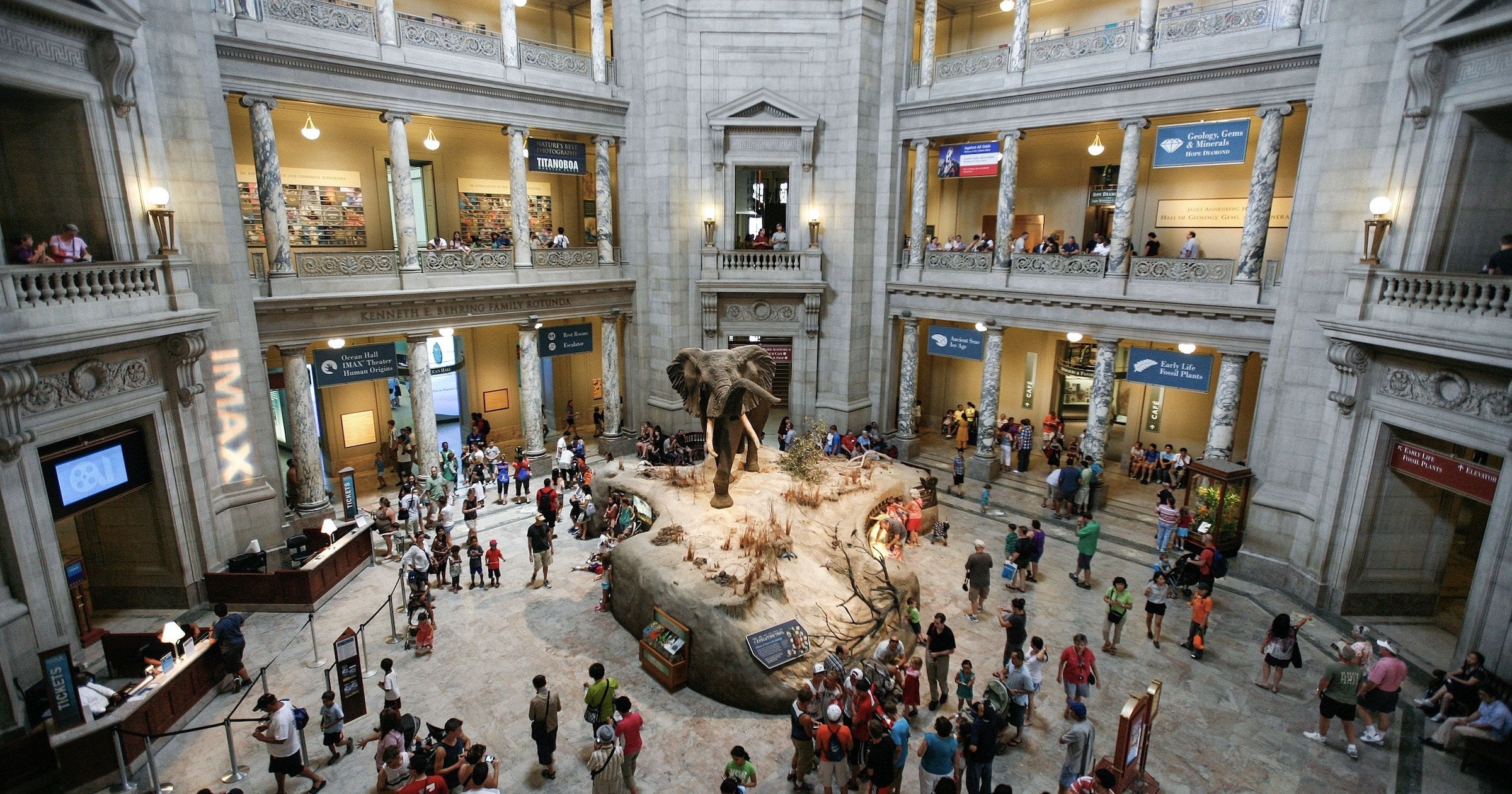
Casey Luskin had an exceptionally well-timed op-ed in the New York Post yesterday. It’s well timed because last week U.S. Senator Jim Banks introduced a bill, as the newspaper reported, to “outlaw the Smithsonian Institution from peddling wokeness and ‘divisive narratives,’ codifying an executive order issued by President Trump back in March.” The law and the executive order forbid the nation’s beloved museum from going on turning itself into a drumbeat of anti-American propaganda. The law “further prohibits future Smithsonian projects that ‘degrade shared American values.’”
Human Beings in Nature
As Dr. Luskin observes, degrading shared values, like the exceptional status of human beings in nature, is just what the Smithsonian’s National Museum of Natural History does in its displays about human origins. Apart from promoting the now-discredited 1 percent myth (that humans are genetically only 1 percent different from chimps), the museum goes out of its way to misinform visitors about how humans are so very, very close to non-human creatures.
From, “Smithsonian exhibit monkeys around with the scientific evidence on human origins”:
The museum’s Human Origins fossil hall claims the ancient species Sahelanthropus tchadensis was an “early human” that walked “on two legs.” But leading paleoanthropologists sharply dispute this claim.
A Nature article found that “Sahelanthropus was an ape,” and many features “link the specimen with chimpanzees, gorillas or both, to the exclusion of hominids.”
A 2020 Journal of Human Evolution paper showed that Sahelanthropus’ femur was like that of a chimp-like quadruped — in other words, it didn’t walk upright, and it wasn’t a human ancestor.
Similarly, the Human Origins exhibit presents the ape-like australopithecines as “early humans” who walked upright “on the ground” much like us. Some paleoanthropologists agree.
But other scientists strongly disagree, pointing out that some australopithecines showed evidence of ape-like knuckle-walking and only limited capacity for running.
Their upright-walking ability was likely best suited for walking along tree limbs, not “on the ground” exactly like we do. Large questions remain about how they walked, and the Smithsonian gives no hint of the scientific controversy.
The museum’s hominid reconstructions also humanize apes while ape-ifying humans. Australopithecus afarensis (the iconic “Lucy”) is portrayed thoughtfully gazing up at the sky, while Australopithecus africanus is presented smiling, perhaps at a friend’s wry remark.
A great piece by Casey Luskin, who provides excellent photographic evidence as well — definitely check it out. And as I understand, the New York Post is prominent in President Trump’s media diet, so we can hope this will come to his attention.
 Photo credit: Casey Luskin.
Wokeness and Cruelty
What’s at stake here? It seems super-sophisticated in some circles to roll your eyes at the idea of “wokeness,” as if the thing didn’t exist or wasn’t harmful. Well, it does and it is. That’s one reason we have to keep reminding ourselves why human exceptionalism matters.
It’s not an ego thing to insist on the distinction between humans and animals, or between humans and non-human hominids. In fact, over the weekend I was reading Ernest Hemingway’s bullfighting book, Death in the Afternoon, and to my surprise he hit on exactly this point. He wrote, “I believe, after experience and observation, that those people who identify themselves with animals, that is, the almost professional lovers of dogs, and other beasts, are capable of greater cruelty to human beings than those who do not identify themselves readily with animals.”
Equating humans with non-humans isn’t humane. It’s the opposite. He’s got a whole discussion of the psychology on that (page 5). He wrote it in 1932. It’s even truer today.